Similarities and differences between qr codes and rfid in inventory management
24
10
In the field of inventory management, two commonly used technologies today are RFID tags and QR codes. Both serve the purpose of tracking goods but the way they work is completely different, each has its own advantages, disadvantages and applications.
The article below will provide an overview of these two technologies, helping you understand the similarities and differences between them.
What is a QR code?
QR codes were invented in 1994 by Denso Wave, a Japanese company. They became popular due to their ability to store large amounts of data and their ease of scanning using smartphones and other devices.
QR codes can encode a variety of information, such as text, URLs, contact details, Wi-Fi network information, etc. They use a combination of patterns and alphanumeric characters to represent the encoded data.
When the QR code is scanned using a QR reader or smartphone, the encoded information is extracted and displayed to the user.
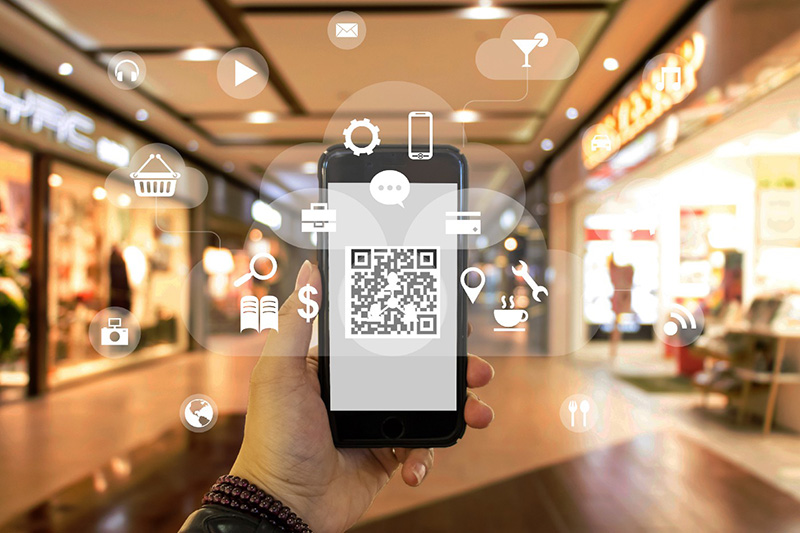
QR codes provide easy access to websites, promotional offers, product information, and more. You can easily find them on event tickets, business cards, product packaging, and even restaurant menus, allowing users to quickly access additional content and perform specific actions like earning points on purchases.
Advantage:
-
Quick and easy scanning: QR codes can be easily scanned using smartphones or dedicated QR code readers, providing a convenient experience for users.
-
Store a lot of data: QR codes have the ability to store large amounts of data, including text, URLs, contact information, etc. This helps provide more information to users with just one scan.
-
Diverse applications: QR codes are widely used in advertising, marketing, product packaging, event tickets and many other fields. This flexibility helps businesses convey information to customers effectively.
-
Easy to create and print: Any individual or business can easily create and print QR codes. This saves costs and time compared to traditional printing methods.
-
Instant access: QR codes allow users to immediately access websites, promotions, product information and multimedia content. This feature enhances user experience and increases engagement.
-
Extensive applications: QR codes can be used for a variety of purposes such as authentication, e-tickets, loyalty programs, and mobile payments. This helps businesses increase the convenience and modernity of their services.
-
Error correction: QR codes have built-in error correction capabilities, allowing accurate scanning even when part of the code is damaged. This feature ensures that users always receive accurate information.
-
Cost-effective solution: Compared to traditional barcodes or manual data entry, QR codes are a cost-effective solution. Businesses can save on printing costs and minimize errors during data entry.
Limit:
-
Internet Dependency: To access the online content embedded in the QR code, the scanning device needs an internet connection. This can be inconvenient in situations where there is no network connection.
-
Limited Compatibility: Some older or limited-feature mobile devices may have difficulty scanning QR codes. This should be kept in mind when implementing QR codes to ensure that the information is accessible to all users.
-
Scannability: QR codes may not scan if they are damaged, poorly printed, or displayed at low resolution. Therefore, print and display quality must be ensured for the QR code to work effectively.
-
Fixed Location: QR codes need to be placed in a fixed location so that users can easily scan them. This limits flexibility in some use cases.
What is RFID?
An RFID system consists of three main components:
-
RFID tag: A compact electronic device consisting of a microchip and an antenna. The microchip stores unique identification data, while the antenna helps in communication by transmitting and receiving radio signals.
-
RFID reader: Emits radio waves and communicates with RFID tags within its operating range. When an RFID tag comes close to the reader, the radio waves activate the tag and communication begins.
-
Back-end system: An infrastructure for processing data collected from RFID readers. This system includes a database, software application or cloud platform to manage and analyze the collected information.
 RFID technology is widely used in many different industries, including retail, logistics, healthcare, transportation, access control and asset tracking.
Advantage:
-
Fast and automatic data collection: RFID allows data on tagged objects to be collected quickly and automatically, eliminating the need for manual data entry. This saves time, labor, and increases operational efficiency.
-
Accurate and comprehensive tracking: RFID systems provide accurate and comprehensive tracking of inventory, assets, or tagged objects. Users can grasp the location, quantity, and status of objects in real time.
-
Minimize errors: RFID minimizes errors due to manual data entry, ensuring the accuracy and reliability of data. This helps make informed business decisions based on accurate information.
-
Strict control of production processes: RFID applications in production help strictly control processes, ensuring products are tracked throughout from raw materials to finished products. This helps improve production quality and minimize risks.
-
Improve product quality and traceability: RFID supports product traceability, helping to identify raw material sources, production time, processing and distribution stages. This increases customer confidence in product quality.
Limitations:
-
High initial investment costs: Deploying an RFID system requires a relatively high initial investment cost for purchasing RFID tags, RFID readers, and building the back-end system.
-
Risk of unauthorized access: RFID systems pose a risk of unauthorized access or data theft if not properly secured. Therefore, appropriate cybersecurity measures should be implemented.
-
Interoperability issues: With different standards and operating frequencies, RFID tags from one vendor may not be compatible with readers from another vendor. This should be kept in mind when selecting RFID devices.
-
Challenges in card disposal and recycling: Some types of RFID tags contain batteries or toxic materials, which pose challenges in handling and recycling after their end of life. Therefore, it is necessary to select the appropriate type of tag and have a safe disposal process.
The difference between QR code and RFID
QR codes and RFID are both effective methods of encoding, storing and retrieving information. However, they operate on different principles and have different applications.
Here are some of the key differences between QR codes and RFID:
Technology and data storage:
QR codes use a 2D barcode system consisting of black squares arranged on a white background. It stores information in a visual format that can be scanned and decoded using a smartphone or a dedicated QR code reader. The data capacity of a QR code can range from a few bytes to several kilobytes.
RFID uses radio waves to transmit data from an RFID tag to an RFID reader. RFID tags can store much more data than QR codes, from a few bytes to several kilobytes or even more.
RFID uses radio waves to transmit data from an RFID tag to an RFID reader. RFID tags can store much more data than QR codes, from a few bytes to several kilobytes or even more.
Phương pháp đọc:
Mã QR được quét bằng cách sử dụng camera điện thoại thông minh hoặc một trình đọc mã QR chuyên dụng. Người dùng phải đưa mã QR vào trường nhìn của máy quét để giải mã và đọc thông tin.
Thẻ RFID truyền dữ liệu không dây đến một đầu đọc RFID bằng sóng radio. Đầu đọc gửi ra tín hiệu radio và khi thẻ vào phạm vi của nó, nó sẽ nhận và phản hồi với thông tin đã lưu trữ.
Scope and interaction:
QR codes require close proximity between the scanner and the code itself. Typically, users must hold their smartphone or scanner a few inches from the QR code to successfully scan it.
RFID tags have a variable range depending on the frequency and power of the reader. They can read from a few centimeters to several meters away, allowing for contactless and automated data collection.
Applications and uses:
Each technology, QR Code and RFID, has its own strengths suitable for different applications.
QR codes are often used in marketing and advertising campaigns to help users quickly access websites, product information or promotions. In addition, QR codes are also used in event tickets, inventory management systems and shipment tracking.
RFID technology is widely used in many industries for tracking and identification purposes. Typical applications include: inventory management, supply chain management, access control, contactless payment systems, asset tracking and animal tracking.
Cost and scalability:
QR codes: QR codes are very cheap to create, easy to print on many different surfaces such as paper, labels, product packaging. QR codes are scalable and can be mass produced at low cost.
RFID technology: Requires the use of dedicated tags and readers, and is therefore more expensive than QR codes. The total cost depends on the type of RFID system, the functionality of the tag, and the required read range. However, in certain applications, especially automated tracking and large-scale operations, RFID systems can offer greater efficiency and scalability.
Security and privacy:
QR codes: Can be easily copied or tampered with, posing a security risk if used for sensitive information. However, encryption and the use of secure QR code generation methods can improve security.
RFID tags: Often offer higher security due to the ability to encrypt and protect data through access control methods. However, unauthorized reading of RFID tags remains a potential privacy concern, as anyone with an RFID reader can access the information without the card owner knowing.
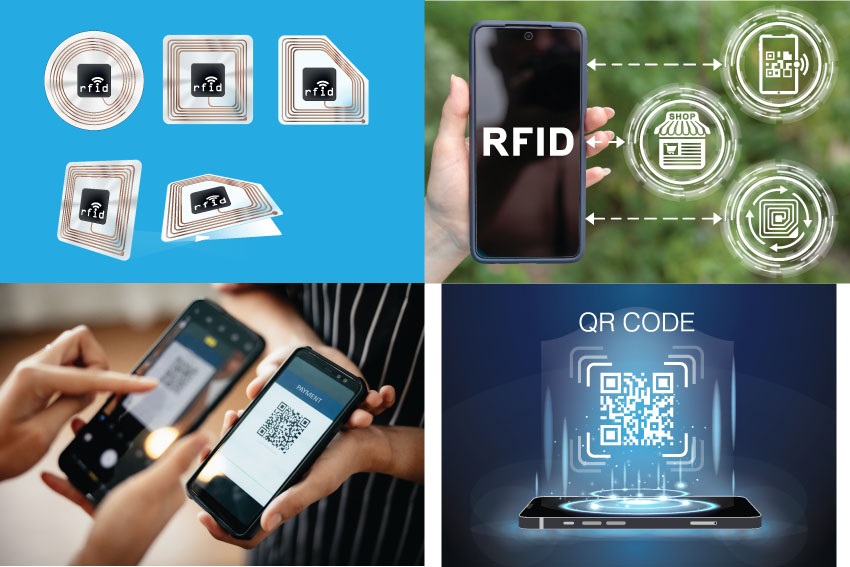
Similarities between QR Code and RFID
Despite their differences, QR codes and RFID also share common characteristics that make them versatile options in many situations.
-
Electronic data storage and transmission: Both QR codes and RFID have the ability to store and transmit information in digital form. This allows for more data storage than traditional methods such as 1D barcodes.
-
Contactless data transmission and collection: Both technologies use contactless methods to transmit and collect data. With QR codes, users simply scan the code with a camera, while RFID uses radio waves to automatically collect information from a distance.
-
Machine readability: Another important similarity is machine readability. This allows for the automation of scanning and data processing, saving time and labor.
-
Enhanced customer experience: The application of QR codes and RFID can help increase customer engagement and engagement. For example, QR codes on product packaging allow quick access to detailed information, while RFID tags on products can support contactless payments, providing a convenient shopping experience.